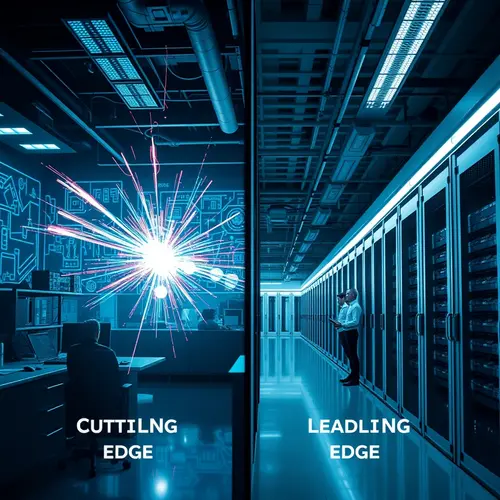
cutting edge technology
The Core Drivers of cutting edge technology
Most people mistake “new” for “cutting edge.” True innovation occurs when a technology disrupts an entire industry’s cost structure or delivery method. For instance, the shift from traditional silicon to gallium nitride (GaN) in power electronics is a prime example of a fundamental hardware leap. Edge computing is another pillar. By processing data closer to the source, businesses eliminate the latency inherent in cloud-only models. This is a requirement for autonomous systems that cannot afford a millisecond of delay.Quantum Computing and the Logic Shift
Classical computing relies on bits. cutting edge technology in quantum computing utilizes qubits, allowing for superposition and entanglement. This enables the solving of complex chemical simulations and cryptographic problems in seconds. Industry consensus from the IEEE suggests that quantum supremacy will redefine pharmaceutical research. Instead of trial and error, molecular modeling happens digitally. This reduces the time to market for life-saving drugs.Technical Comparison: Legacy vs. Modern Infrastructure
| Feature | Legacy Systems | cutting edge technology |
|---|---|---|
| Data Processing | Centralized Cloud | Distributed Edge Computing |
| Compute Logic | Binary (0 or 1) | Probabilistic (Qubits) |
| Connectivity | Fixed Bandwidth | Dynamic, Low-Latency Mesh |
| Scaling | Vertical (Hardware Upgrade) | Horizontal (Elastic Clusters) |
Practical Implementation Strategies
Implementing cutting edge technology requires a strategic approach to avoid “pilot purgatory.” This is when a company tests a tool but never scales it because of integration friction.- Audit Existing Debt: Clear out legacy code before layering new tools.
- Prioritize Interoperability: Ensure new APIs can communicate across different platforms.
- Upskill Staff: Focus on mental models rather than specific software versions.
- Iterative Deployment: Start with a high-impact, low-risk internal project.
Expert Opinion: The “Hype Cycle” Trap
Many executives chase the latest buzzword without analyzing the underlying utility. In my experience, the biggest mistake is implementing a tool because a competitor did, regardless of the actual business outcome. Myth: You need a massive budget to innovate. Fact: Open-source frameworks often provide the most cutting edge technology available. The value is not in the license fee, but in the engineering talent that implements it. Consider a hypothetical scenario where a logistics firm adopts AI-driven route optimization. If they simply buy a SaaS product, they gain a temporary edge. If they build a proprietary model based on their unique data, they create a permanent competitive moat.Security in the Age of Advanced Computation
As compute power grows, traditional encryption fails. This creates a need for post-quantum cryptography. Standard RSA encryption becomes vulnerable when faced with Shor’s algorithm. According to NIST guidelines, the move toward lattice-based cryptography is the only way to secure data against future threats. This shift is a critical component of cutting edge technology strategy for any entity handling sensitive information. Zero Trust Architecture is the gold standard here. It assumes the network is already compromised. Every request is verified, regardless of where it originates.The Long-Term Outlook for Industry Integration
The trajectory of innovation points toward seamless integration. We are moving away from standalone devices toward ambient intelligence. Technology becomes an invisible layer that responds to human intent in real-time. The most successful organizations will be those that treat cutting edge technology as a tool for efficiency rather than a trophy for the boardroom. Focus on the problem first, then the tool. Integrating these systems requires a culture of continuous learning. When the foundation is built on scalable architecture and secure protocols, the transition to the next wave of cutting edge technology becomes a routine update rather than a risky overhaul.
Related: IT solutions for business growth.
Source: NIST emerging technology resource.
How to Choose the Right Solution
Start with the problem, not the tool. List three pain points, then score each option on fit, cost, security and support. Pilot one team for 30 days before wider rollout.
| Option | Best for | Cost | Risk |
|---|---|---|---|
| Incremental upgrade | Stable teams | Low | Low |
| New platform pilot | Growth teams | Medium | Medium |
| Full rebuild | Scale stage | High | High |
Who Should Adopt First
Growth-stage firms with in-house support benefit most. Small teams should wait for managed versions. Regulated firms must confirm compliance before any pilot.
Verdict: pick one pilot, set a clear success metric, and scale only what proves value within 90 days.
Implementation checklist: define the goal, assign one owner, set a 30-day deadline, track two metrics weekly, and review results with the team. Document lessons, keep backups of key configs, and schedule a quarterly review to confirm the setup still fits current needs and budget.
Field note: run the pilot with real data, limit access by role, and log every change. Train two staff members, keep a one-page runbook, and set alerts for errors. After 30 days, compare cost, speed and satisfaction before deciding to expand, pause or roll back.
Quick win: document the performance baseline this week today, then re-measure after the pilot to prove gains to stakeholders clearly now today.
Further reading on this site:
- tech support for small businesses
- data visualization telling stories with data
- data analytics in marketing personalizing the customer experience
- the world of internet marketing transforming business strategies in the digital age
- cloud computing revolutionizing the digital era
- data mining discovering hidden insights
What is cutting edge technology?
It is newly proven tech that delivers major gains over legacy tools, once tested beyond the lab stage.
How do you adopt it safely?
Start with one pilot, measure results, train staff, then scale what proves reliable and secure.
When should you avoid it?
Avoid unproven tools for critical systems. Wait for stable support and clear security updates.
About the Author