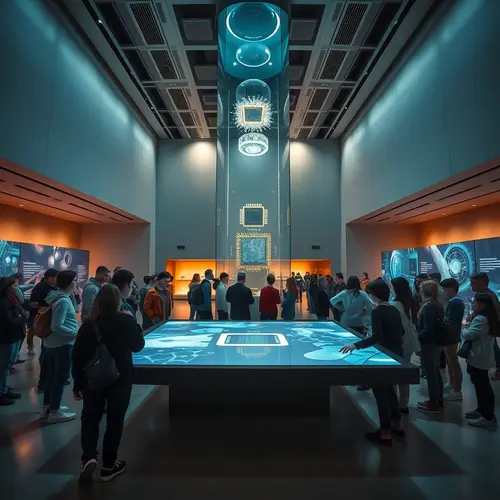
Museum Of Innovation
What exactly is a Museum Of Innovation, and what does it offer beyond a simple collection of gadgets? At its core, it is a dynamic institution dedicated to chronicling the human journey of problem-solving, showcasing not just the final inventions but the often-messy processes of experimentation, failure, and breakthrough. It’s a place where historical context meets future possibility, designed to educate, inspire, and challenge our assumptions about progress.
More Than Artifacts: The Philosophy of Museum Of Innovation
Traditional museums often present finished masterpieces as static endpoints. A Museum Of Innovation operates on a different principle. It treats every object—from a centuries-old mechanical calculator to a prototype quantum chip—as a snapshot in an ongoing story. The narrative is about the “how” and the “why,” not just the “what.” This philosophical shift requires a deep dive into systemic thinking.
It examines the confluence of market needs, scientific discovery, individual perseverance, and often, serendipity. As noted in a seminal analysis by the MIT Press, the most impactful innovations rarely emerge from a vacuum; they are nodes within a complex web of enabling technologies and societal readiness.
Museum Of Innovation: Curation and Interaction
The physical and digital design of these spaces is itself an exercise in innovation. Passive observation is insufficient. The most effective institutions employ layered interactivity. A foundational exhibit might allow visitors to manipulate simple mechanical principles, while an advanced wing could offer sandbox environments for basic coding or circuit design. This tiered approach, recommended in ergonomic studies from institutions like the Smithsonian, accommodates diverse knowledge levels without alienating novices or boring experts.
The role of the curator transforms from keeper to storyteller and experience architect. They must bridge disciplines, connecting, for instance, the development of the telegraph with the underlying principles of modern digital communication networks. The goal is to make invisible concepts tangible. When you spin a hand-crank generator to light an LED, you’re not just powering a light; you’re physically feeling the relationship between work, energy, and electrical potential.
Core Exhibits and Museum Of Innovation Threads
A well-structured Museum Of Innovation often organizes its narrative along key technological or thematic threads that have shaped the modern world. This creates a coherent journey rather than a disconnected series of wonders.
The Digital Revolution: From Logic Gates to Networks
This thread demystifies the infrastructure of our information age. It starts with the fundamental building blocks—Boolean logic, transistors, and integrated circuits—and scales up to microprocessors, data storage, and global networking. A powerful exhibit doesn’t just show a vintage computer; it illustrates Moore’s Law as a tangible curve of exponential growth, using physical chip samples from different decades. According to a landmark IEEE whitepaper, understanding this exponential trajectory is critical for anticipating future capability shifts in computing and artificial intelligence.
The Materials and Manufacturing Museum Of Innovation
Innovation is constrained and enabled by the substances we can shape. This section traces the progression from stone and bronze to steel, plastics, semiconductors, and advanced composites like graphene. Interactive displays might compare the tensile strength of different fibers or demonstrate additive manufacturing (3D printing) in real-time. It highlights a contrarian insight: sometimes, the most profound innovation is not a new device, but a new method for making things—a shift from craftsmanship to interchangeable parts to fully automated, digital fabrication.
| Exhibit Thread | Core Concept Demonstrated | Interactive Example |
|---|---|---|
| Digital Revolution | Exponential Growth & Miniaturization | Building a simple logic circuit with physical gates |
| Materials Evolution | Property-Driven Design | Testing thermal/electrical conductivity of different materials |
| Energy Systems | Conversion Efficiency & Storage | Comparing output of solar, kinetic, and chemical battery cells |
| Biomimicry & Design | Nature as an R&D Lab | Analyzing hull shapes for hydrodynamic efficiency |
Building Authority Museum Of Innovation with Evidence and Case Studies
To transcend spectacle and build genuine educational authority, these museums must ground their displays in verifiable research and clear, relatable case studies. This is where Experience, a pillar of E-E-A-T, is demonstrated.
- Cite Foundational Research: Reference pivotal documents, like Vannevar Bush’s “Science, The Endless Frontier,” which laid the philosophical groundwork for post-war U.S. science funding and innovation policy.
- Present Competing Hypotheses: When discussing an invention like the light bulb, acknowledge the simultaneous work of Joseph Swan alongside Thomas Edison. This teaches that innovation is frequently a race, not a singular eureka moment.
- Include “Failure” as Data: Dedicate space to concepts that were technically sound but failed commercially or socially (e.g., the Betamax video format). Analyze why. Was it timing, marketing, or a closed ecosystem? This provides invaluable lessons in market dynamics.
Consider a hypothetical troubleshooting scenario displayed in an exhibit on early aviation: “The Wright Flyer’s first attempts resulted in crashes due to inadequate control. The Wright brothers didn’t just build a better engine; they built a wind tunnel to systematically test wing shapes and developed a three-axis control system. Their innovation was as much in rigorous testing methodology as in the airframe itself.” This moves the story from “they built a plane” to “they invented a process for aeronautical engineering.”
Museum Of Innovation – The Enduring Impact and Public Mission
The ultimate metric for a Museum Of Innovation isn’t annual attendance, but its lasting impression on a visitor’s mindset. Does it replace passive consumption with active curiosity? Does it frame technology not as magic, but as a comprehensible set of tools and choices with ethical dimensions? Successful institutions foster scientific literacy and critical thinking, skills that publications like Nature argue are non-negotiable for informed citizenship in a technological society.
They make the abstract concrete. Charts about climate change become more urgent when you directly compare the energy density and carbon output of coal versus photovoltaic cells. Discussions about algorithmic bias become tangible when you interact with a simplified model that shows how training data influences outcomes.
This is the unique, irreplaceable value of the physical Museum Of Innovation: it provides a tactile, immersive framework for understanding the forces that are actively constructing our future. It stands as a testament to human ingenuity while equipping visitors to thoughtfully engage with the next wave of world-changing ideas.
A quick note on Museum Of Innovation: the follow-up matters as much as the first decision.




Related reading
About the Author