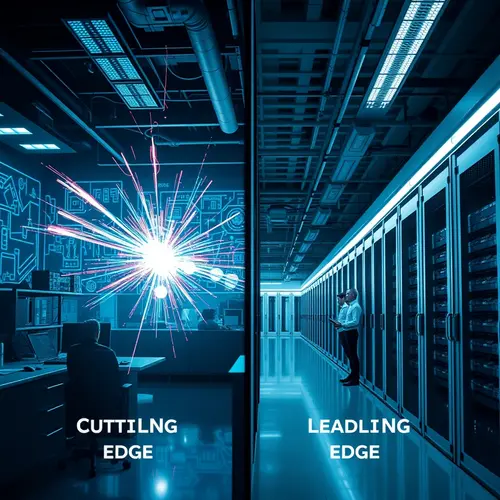
cutting edge vs leading edge
When deciding between cutting edge vs leading edge, the difference boils down to risk and stability. Cutting edge refers to the most advanced, unproven technology that pushes boundaries, while leading edge refers to high-performance technology that is proven, reliable, and ready for wide-scale adoption.
Defining the Technical Divide: Cutting Edge vs Leading Edge
The confusion between these two terms often leads to expensive procurement mistakes. In a technical environment, choosing the wrong path can mean the difference between a successful rollout and a system failure.
Cutting edge technology is the “bleeding edge.” It exists in laboratories or beta tests. It represents the absolute frontier of what is possible, often lacking documentation and long-term stability tests.
Leading edge technology is the gold standard. It is the most advanced version of a technology that has been vetted. It offers high performance without the volatile instability of experimental prototypes.
Risk Assessment in Cutting Edge vs Leading Edge Implementations
Engineers and CTOs must weigh the cost of failure against the reward of early adoption. If a company adopts a cutting edge tool, they risk downtime and lack of community support.
Leading edge tools provide a competitive advantage without risking core operations. These tools are typically supported by established vendors and have a documented track record of success.
According to industry frameworks outlined by the IEEE, the transition from experimental to standardized technology requires rigorous validation phases. This process is what moves a product from the cutting edge to the leading edge.
| Feature | Cutting Edge | Leading Edge |
|---|---|---|
| Risk Level | Very High / Experimental | Moderate / Validated |
| Reliability | Unpredictable | Consistent |
| Support | Developer-led / Community | Enterprise-grade / SLAs |
| Adoption | Early Adopters / Visionaries | Pragmatists / Early Majority |
Practical Application and Industry Impact
Consider a software company implementing a new database architecture. Using a cutting edge NoSQL variant might offer a 10% speed increase but could crash under heavy load.
Choosing a leading edge solution ensures the company gets top-tier performance. This approach balances innovation with the need for 99.9% uptime.
Most Fortune 500 companies avoid the absolute frontier. They prefer the leading edge because it allows them to stay competitive without jeopardizing their infrastructure.
Expert Opinion: The “Bleeding Edge” Trap
Many managers confuse “newest” with “best.” In my experience, the most dangerous mistake is deploying cutting edge vs leading edge solutions without a sandbox environment.
I once witnessed a firm implement an experimental AI framework for their primary payroll system. The system failed during a peak cycle because the technology was too raw. They had chosen the cutting edge when the leading edge would have provided the same result with zero risk.
The myth is that being the first to adopt always equals a win. The reality is that being the first to fail is a costly lesson. Aim for the leading edge for production and the cutting edge for R&D.
How to Choose the Right Path for Your Business
To decide which path to take, evaluate your organization’s risk tolerance. Use the following checklist to determine your strategy:
- Budget: Do you have the capital to absorb a total system rewrite if the tech fails?
- Talent: Do you have engineers who can write their own patches and documentation?
- Criticality: Is this tool for a non-essential internal project or a customer-facing product?
- Timeline: Can you afford a six-month delay for troubleshooting and debugging?
If you answered “No” to more than two of these, stay away from the cutting edge. Stick to the leading edge to ensure business continuity.
Industry reports from Gartner emphasize that the “Trough of Disillusionment” often hits those who jump too quickly into experimental tech. This is why a strategic balance is necessary.
Strategic leadership involves knowing when to experiment. Use a small, isolated team for cutting edge vs leading edge testing. Once the experimental tool proves its worth, migrate the rest of the organization to the leading edge version.
Understanding the nuances of cutting edge vs leading edge allows a business to innovate safely. By separating experimental R&D from production environments, you maximize growth while minimizing catastrophic risk.
TAGS: technology strategy, risk management, software engineering, IT infrastructure, enterprise architecture, tech adoption, innovation management
About the Author